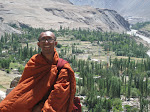
Sumanapal Bhikkhu
The destruction of Buddhist monastic establishments like Nalanda, Vikramshila and Odantapuri marked the ultimate and rapid decline of Buddhism in India. After centuries of slumber it was finally revived by sincere and selfless efforts of some great men with unending energy, profound devotion and indomitable spirit. Sanghanayaka Dharmapal Mahathera was one of them.
Dharmapal Mahathera was born on December 12, 1925 in Ramu of Chittagong district of East Pakistan now Bangladesh. He was the third son of Rajani Kumar Barua and Pranayani Barua. At the age of 13 he was initiated as a Samanera in the year 1938. In 1945 he received Higher Ordination or Upasampada under Ven Jnaniswar Mahasthabir a renowned monk from Unainepura Lankaram which was also the birthplace of Ven Kripasaran Mahasthabir, the founder of the Bauddha Dharmankur Sabha or Bengal Buddhist Association. He passed the complete course of nine years on Vinaya- Sutta- Abhidhamma and received two goal medals for becoming First Class First in Vinaya and Abhidhamma examinations. In 1948 he came to Calcutta and participated in the activities of the Dharmankur Sabha. He never hankered after posts but kept on working in silence. In 1950 by his personal efforts and strong determination he successfully revived Jagajjyoti ( a journal on Buddhism, first published by Kripasaran Mahasthabir in 1908) edited by Pandit Shilananda Brahmachari who was a scholar and author of various important books on Buddhism. In 1952 he attended the installation ceremony of the holy relics of Sariputta and Mogallana two prominent disciples of the Buddha in Sanchi of Madhya Pradesh in a programme organised by the Mahabodhi Society of India. These relics which were brought from London Museum to Calcutta and received by Pandit Jawaharlal Nehru were handed over to the Mahabodhi Society.
In 1954 Dharmapala Mahathera took part Chhattha Sanghayana (Sixth Buddhist Council) sponsored by the Burmese Government under the patronage of Unu the Prime Minister of the then Burma. The Sanghayan journal published a report on the event as well as his photograph. In 1955 he was elected Secretary of the Sabha and held the post upto 1975.
He took part in the 2500th celebration of Buddha Jayanti in January of the year 1957 that took place at Nalanda Park of Calcutta. The programme was organised by Dharmankur Sabha and attended by the 21 year old His Holiness the Dalai Lama and Panchen Lama. The programme was presided over by Dr Bidhan Chandra Roy the then Chief Minister of West Bengal.
In 1959 he was invited to Burma (Myanmar) by the Union Government of Burma to discuss
how to propagate Buddhism in India. There he practiced Vipassana meditation at Sasana Yeikhta of Rangoon under the supervision of Mahasi Sayadaw a great meditation teacher of international repute.
In 1965 he organised the centenary celebration of Kripasaran Mahathera, founder of the Sabha. The function was inaugurated by the then Chief Minister of West Bengal P C. Sen and presided over by Justice Ramprasad Mukherjee.
In November 1966 he participated in the 8th Conference of the World Fellowship of the Buddhists at Changmai of Thailand.
In 1967 he established Kripasaran Continental Institution in the campus of the Sabha. Since then the institution has been working non stop. The primary school has the reputation of being one of the best schools of the adjoining locality. This English medium school has established itself as a centre of cultural unification and national integration with secular credentials. In 1969 he participated in the 9th Conference of the World Fellowship of the Buddhists held at Kualalampur and Penang of Malaysia. He attended the conference of the World Buddhist Sangha Council held in Saigon of Vietnam and elected
as the member of the Sangha Council.
In 1970 the Govt of Bihar nominated him as a member of the Buddhagaya Temple Advisory Board. The movement for the revival of Buddhism started with the demand that the management rights of the Buddhagaya Temple (Mahabodhi Temple) be handed over to the Buddhists. This movement became particularly successful when in the year 1950 the Bihar Legislative Assembly passed an act which provided for the formation of a new Management Committee with four Buddhists and four Hindus with the District Magistrate of Buddha Gaya as the Chairman for the affairs of the Temple. The Advisory Board consisted of representatives from all Buddhist countries regarding the development of Buddha Gaya.
In 1972 he participated in the 10th Conference of the World Fellowship of Buddhists held in Sri Lanka accompanied by Netra Ranjan Barua. There they succeeded in registering the name of Kripasaran Mahasthabir , the founder of the Sabha in the history of the World Fellowship of Buddhists for the invaluable services rendered to the cause of revival of Buddhism in India alongwith the names of Anagarika Dharmapala and Dr B R. Ambedkar.
He took initiative to purchase a plot of land with an area of 2520 sq ft for the Sabha. He made this difficult task easy by means of his personal care, enthusiasm and indomitable energy. In 1973 he visited Japan and delivered lectures in different universities and cultural organizations namely Tokyo University, Waseda University Osaka University, Meiji University of Nagoya, Rissho Kosei- Kai, Kodo Kyodan and the Eastern Institute. During his stay in Japan he received help and assistance from Kazuo Azuma, a noted Rabindra researcher in Japan. With this visit a cultural link with Japan was established. After that he established Kripasaran Homoeo Dispensary which was inaugurated by Ajit Panja the then Health Minister of West Bengal.
In 1974 he was appointed Hony Lecturer of Calcutta University and remained in his post upto 1985. In he purchased a plot of land of 16 kathas at Rajgir for the Sabha. In 1978 he was elected General Secretary of the Sabha and continued in office up to 2004. In 1978 he went to Japan for the second time for participating in 11th Conference of the World Fellowship of Buddhists in Tokyo. In 1979 he organised Bharatiya Bangalee Bauddha Sammelan (All India Bengalee Buddhist Conference) under the auspices of the Sabha, led a silent procession as a protest against the specification of Buddha Purnima as sectional holiday by the Govt of West Bengal and demanded Buddha Purnima as a public holiday in the state of West Bengal.
Under the patronage of Kripasaran Continental Institution he organised the celebration of International Year of Children. The programme was inaugurated by Dr Hajime Nakamura, the world famous Indologist of Japan. In the same year he puchased a plot of 8 kathas at Sarnath for the Sabha. In the same year he was elected as the Secretary General of the All India Bhikkhu Sangha and continued upto 1985. In 1986 the publication of the quarterly bilingual magazine was started under the editorslhip of Hemendu Bikash Choudhary a well known writer, poet and the winner of many awards. Under guidance of Dharmapala Mahathera and Hemendu Bikash Choudhary the journal got a wide readership with a new look generating a sensation both at home and abroad and acquired international acclaim.
In 1981 he led the sellven member Buddhist Cultural delegation to the erstwhile Soviet Russia and Mongolia. He participated in the Silver Jubilee Celebration of Bodhi Society at Jamshedpur. In 1982 he attended the Conference of the Buddhist leaders and scholars held in Sri Lanka with Shilananda Brahmachari. Under the auspices of the Sabha he organised the millennium birth celebration of Atish Dipankar Srijan the famous monk scholar of the 10th century on an international level in Rabindra Sadan of Calcutta. Mr Nissanka Wijeyeratne Honourable Minister of Justice Sri Lanka inaugurated the function which was presided over by honourable His Holiness Dalai Lama.
An international seminar on Atisha was also held at Indian Museum in which Atisha millenium birthday celebration volume was published under the editorship of Hemendu Bikash Choudhary. Ven Khambo Lama of Buriat laid the foundation of Atisha Memoetial Building on the concluding day of the celebration on 31st January at the campus of the Sabha.
He participated in 1000th birth anniversary celebration of Atisha organised by Bangladesh Bouddha Kristi Prachar Sangha. in Dhaka from 26th February to 4th March. In 1984 he participated in the 99th birth anniversary celebration Ven Nichidatsu Fuji ( called Guruji by Mahatma Gandhi) at different parts of Japan. In 1984 he participated in the First International Conference on Buddhism and National Cultures held a Bijan Bhavan, New Delhi.The programme was inaugurated by Indira Gandhi, the then Prime Minister of India. More than 400 scholars from 41 countries took part in this week long conference (10th--15th October) hosted by Indian Council for Cultural Relations (ICCR), Indian Council for Philosophical Research,(ICPR) Indian Council for Historical Research ( ICHR), in collaboration with Indian Council of Social Science Research, Sahitya Academy, Sangeet Natak Academy, Lalit Kala Academy and University Grants Commission (UGC). In the same year he participated in the birth centenary celebrations of Ven Luang Phor of Wat Pakham Bhasicharoen, Bangkok Thailand organised by his disciple Ven Phra Dhammadhirajamahamuni.
In the same year he organised foundation laying ceremony of Bhikkhu Training Centre in Buddhagaya in the procured land of the All India Bhikkhu Sangha. It was his serious and sincere endeavour perseverance and tenacity that helped in procuring one acre of land from the Government of Bihar after facing many tough hardles.
In 1985 he participated as Chief Guest in 500th birth anniversary of Sree Chaitanya Mahaprabhu held at Dakshineswar Kali Temple. After his speech Bharat Ratna Ravi Sankar played on his sitar which kept the spectators enthralled for hours. He felicitated Ven Khambo Gaaden a top most Buddhist leader of Mongolia and President of the Asian Buddhist Conference for Peace, Ulan Bator at the campus of the Sabha. In 1986 he at the campus of the Sabha organised a three day Convention on world peace which was inaugurated by Justice Samsuddin Ahmed
In 1987 he organised the inauguration ceremony of Atisa Memorial Building (Atisa Bhavan) on 6th February. Rev Motoyuki
Nagnuma the then Chairman of the Board of Directors of Rissho Kosei- Kai of Japan inaugurated the function and Professor Ramaranjan Mukherjee the then Vice Chancellor of Rabindra Bharati University and President of the Sabha presided over the function This construction project was undertaken in the year 1983 and was completed in the year 1987. It was constructed mainly by the fund made available by Rissho Kosei- Kai and other
Japanese friends and well wishers.
In the same year he participated in the 60th birth anniversary celebration of his Majesty the King of Thailand. In 1988 he participated in the 16th Conference of the World Fellowship of the Buddhists held in Los Angeles USA alongwith the President of the Sabha, Venerable Jinaratan Mahathera. In the year same year he organised the birth centenary celebrations of Professor B.M. Barua, a great Indologist and an acknowledged authority on Buddhism and former General Secretary the Sabha and former editor of Jagajjyoti under the auspices of the Sabha. Ven Visuddhananda Mahathera of Bangladesh inaugurated this function on 31 December at Indian Museum, Calcutta and Dr Ashin Dasgupta Director of the National Library presided over the function and Honourable Justice Chittatosh Mookherjee was present as Chief Guest.
In 1989 he organised a seminar on the life of Professor Barua on 1st January On the occasion Dr B.M. Barua Birth Centenary Volume edited by Hemendu Bikash Choudhary was published. The volume was released by Dr Pratap Chandra Chanda on 5th February at Ashutosh Auditorium in Calcutta. Justice Anandamoy Bhattacharya and Professor Bratindranath Mukherjee were Chief Guest and Chief Speaker respectively. In the same year he organised the opening ceremony of allopathy free medical centre as Niwano Free Medical Centre. It has been named after the great personality Rev. Nikkyo Niwano, the founder of the Rissho Kosei- Kai the world renowned lay Buddhist philanthropic organisation of Japan. In 1990 he participated in the opening ceremony of Buddhist broadcasting channel in South Korea. In the same year the 125th birth anniversary of the founder of the Sabha was observed. In the function Kripasaran Mahathera
125 birth anniversary Volume was published. It was edited by Hemendu Bikash Choudhary.
In 1991 he organised the birth centenary celebration of Bodhisattva Dr B.R. Ambedkar held at Ashutosh Centenary auditorium of Indian Museum Calcutta under the auspices of the Sabha. The celebration was inaugurated by His Excellency Raja Tridib Roy the Ambassador of Pakistan to Argentina. The
function was presided over by Bhakti Bhusan Mondal, a minister of Government of West Bengal. He also arranged for the publication of Dr B R Ambedkar birth centenary Volume edited by Hemendu Bikash Choudhary.
He was also nominated as Member of the Babasaheb Ambedkar Centenary National Celebration Committee constituted by the Government of India.
In 1993 he organised the Centenary Celebration of the Sabha. Although plans were afoot to celebrate the occasion on a much larger scale circumstances forced it to observe in a different way. Keeping in mind the tragic events of December 6th, the Celebration was dedicated to the maintenance of 'Communal Harmony and World Peace' All religion prayer meeting and a silent procession of all faiths for communal harmony were held. The celebration was inaugurated by Honourable Anandamoy Bhattacharya, Chief Justice of Calcutta High Court. In this year the book 'Hundred Years of Bauddha Dharmankur Sabha' was published. It was edited by Hemendu Bikash Choudhary and was received with wide acclaim.
He carried the sacred relics of Lord Buddha to Mongolia with a Government Delegation led by Ms Kumari Shailaja, Minister of Government of India. Then he was elected President of the All India Bhikkhu Sangha. In 1994 he was nominated as a member of Nava Nalanda Mahavihar Society by the Government of India. This institute of learning was inaugurated by the Government of Bihar in 1956 near the ruins of ancient Nalanda.Ven Jagadish Kashyap was its founder director and it was inaugurated by Dr S. Radhakrishnan the then Vice President of India.
He acquired a plot of land measuring 80X 80 metres in Lumbini, Nepal from the Lumbini Development Trust for the construction of a Bharatiya Sangharam. He arranged for the publication of Mahapandita Rahul Sankritiyana Birth Anniversary Volume edited by Hemendu Bikash Choudhary. The Volume was formally released by Binoy Krishna Chaudhary the then Minister in Charge of Land and Land Revenue Govt of West Bengal in a function held in the Campus of the Sabha under the Presidentship of the celebrated Japanese Tagore expert Kazuo Azuma. He organised a lecture on 'An Interpretation of the Contemporary Japanese Society by Professor Chie Nakane an eminent anthropologist of Japan under the auspices of the Sabha and Visva Bharati. In 1985 he carried the sacred relics of the Buddha to South Korea on behalf of the Government of India. In the same year he attended the cremation ceremony of Mahasangha nayaka Visuddhananda Mahathera in Chittagong Bangladesh. In 1996 he organised the 65th birth anniversary of Kazuo Azuma, a noted Rabindra researcher and scholar of Japan under the auspices of the Sabha. Professor Nimai Sadhan Basu ex Vice Chancellor of Visva Bharati and Sunil Gangopadhyay the eminent writer were present as President and Chief Guest respectively. On the occasion a book entitled 'Prasanga Kazuo Azuma' edited by Hemendu Bikash Choudhary.
In 1997, he published Asoka 2300, a prestigious publication of the Sabha after an hiatus of 2300 years. The Volume was released by Dr U N. Biswas under the Presidentship of Professor Dilip Biswas, President of Asiatic Society Calcutta. The unstinted efforts of the editor Hemendu Bikash Choudhary deserves the appreciation for enhancing the intellectual level of the Sabha.
In the same year he attended the International Religious Summit held at Mount Hiei of Japan.
In 1998 he visited Centre of Xuan Xang (Hiuen Tsang) studies, Buddhist Association of China and other places in China. This visit opened up new vistas for Indo China cooperation.
In 1999 he organised inaugural function of Saptaparni Vihar and Rapida Meditation Centre at Rajgir branch of the Sabha. This magnificent complex has come up with his singular effort with financial support by his Japanese disciple Kazuharu Sakashita and his friend Rev Norio Yamamoto.
He organised inauguration of Xuan Xang (Hiuen Tsang) Centre for Buddhist studies by
Pratap Chandra Chanda at the Campus of the Sabha in presence of Ven. Yuan Ming Master , Deputy Secretary General of the Xuan Xang Research Centre, Beijing.
He handed over a cheque of Rs 25000 towards the relief of Kargil victims, on behalf of the Sabha to Hon'ble Governor of West Bengal, Justice Shyamal Kumar Sen at Rajbhavan. He handed over a cheque of Rs 10000/ towards the relief of Super Cyclone victims on behalf of the to Hon'ble Chief Minister of West Bengal Sri Jyoti Basu at Writers' Building, Calcutta. He participated as President in the Sanghanayaka Anandamitra Mahathera Memorial meeting at the campus of the Jagajjyoti Vihar Sabha, New Delhi. He published Professor G P Malalasekara Birth Centenary Volume edited by Hemendu Bikash. Professor Malalasekara, a renowned Buddhist scholar and founder president of the World Fellowship of Buddhists was a dominant figure in the cultural life of Sri Lanka. In 2000 he was elected Sanghanayaka of the All India Bhikkhu Sangha. He breathed his last on 14th March of the year 2009. Sanghanayaka Dharmapal Mahathera was an exemplary character whose hard work simple life and self discipline earned the admiration and respect from everyone. He was a great leader who could inspire by his devotion and selfless sacrifice for the cause of the Dhamma. In his birth centenary we would offer him our heartfelt gratitude and respect. But our true tribute for him will be to work tirelessly like him for the advancement and progress of the Dhamma.

No comments:
Post a Comment