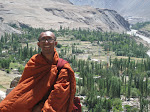
Sumanapal Bhikkhu
Respected dignitaries, learned scholars, members of the faculty, and esteemed participants present here today,
At the very outset, I wish to place on record my sincere gratitude to Mr. Ujjal Ray, Director, and to all the members of the Department of Historical Studies, for extending to me the honour of chairing this scholarly session on Buddhist Medicine and Healing Techniques. I am deeply thankful for the trust reposed in me. I also extend my warm appreciation to all those whose efforts have gone into organising this gathering with such care and intellectual commitment.
I would further like to express my heartfelt thanks to the learned audience present here today. Your presence, attention, and engagement have transformed this occasion into a meaningful and successful academic exchange.
Buddhism and medical science share an intimate and profoundly organic relationship. Within the Buddhist worldview, the Buddha may be seen as the supreme physician, the Dhamma as the method of healing, the Saṅgha as the compassionate caregiver, and the laity as those seeking relief from suffering. This medical metaphor is not incidental; it is foundational to Buddhist thought and practice.
The Buddhist Saṅgha possesses a long and distinguished history of medical care, reflecting a tradition that is both humane and intellectually rigorous. While medical knowledge was likely present among many wandering ascetic fraternities in India from the sixth century BCE, it was within the Buddhist monastic community—particularly after monks began residing in monasteries—that medicine was systematised and codified. The Jain tradition, although possessing its own medical practices, did not develop a comparable codified system, largely due to its doctrinal emphasis on suffering as an essential component of spiritual discipline. Consequently, Jain monasticism did not institutionalise medicine in the manner Buddhism did.
Life within the Buddhist Saṅgha was governed by a balanced ethic: one was to care for the body sufficiently so that hunger and illness did not obstruct spiritual pursuit, yet moderately enough to prevent indulgence from becoming a distraction. The principal aim of medical care within monasteries was the alleviation of pain and suffering. Medicines were largely procured through the generosity of the laity. Initially, monks confined their medical care to fellow monks alone.
To guide this process, the Mahāvagga carefully delineates the characteristics of easy and difficult patients, as well as competent and incompetent caregivers. An easy patient is one who follows beneficial advice, observes moderation, takes medicine at the proper time, and communicates his condition clearly to the caregiver. A difficult patient exhibits precisely the opposite traits.
An efficient caregiver, on the other hand, is described as one who is capable of administering medicine, who understands what is beneficial and what is harmful, who provides what aids recovery and removes what hinders it, who tends the sick out of compassion rather than personal gain, who willingly cleans bodily waste without aversion, and who comforts the patient with timely words and teachings drawn from the Dhamma. An incompetent caregiver is defined by the absence of these qualities.
That nursing a fellow monk was regarded as a sacred responsibility is evident from the fact that, upon a monk’s death, his alms bowl passed not to the Saṅgha, but to the monk who had cared for him during illness.
This entire system of medical care rests firmly upon the Buddhist principle of karuṇā, or compassion, and upon the vision of the Buddha as the greatest and most incomparable physician. The tradition began with the use of herbal remedies and disciplined health practices aimed at maintaining physical fitness. Over time, monasteries established infirmaries and hospitals, and gradually emerged as centres of healing where members of the general public also received medical attention. Within this evolving system, Āyurveda came to occupy a significant role.
The very foundation of Buddhism—the Four Noble Truths—is structured in the form of a medical diagnosis and prescription. First, suffering is identified as the disease; second, its cause is diagnosed; third, the possibility of cure is affirmed; and finally, the path leading to that cure is prescribed. It is therefore unsurprising that Pāli sources frequently refer to the Buddha as “the great and incomparable physician.”
The Buddha accorded paramount importance to physical health, recognising illness as a serious impediment to spiritual awakening. Guided by this understanding, he established an elaborate system of healthcare within the monastic community. His injunction—“Whoever would tend me should tend the sick”—stands as one of the most powerful ethical mandates in Buddhist history. Caring for the sick was declared a duty incumbent upon every member of the Saṅgha.
Early Buddhist texts prescribe strict rules concerning personal hygiene, alongside dietary recommendations involving gruels, milk, honey, garlic, and other substances to address various ailments. Beyond diet, monks and Buddhist physicians made extensive use of plant- and mineral-based medicines to treat conditions such as headaches, jaundice, and eye diseases. Ingredients like turmeric, ginger, and certain animal products were employed when necessary.
Although the formal study of medicine was not compulsory for monks, many undertook it out of compassion for their fellow beings. The most celebrated physician of the Buddha’s time was Jīvaka Kumārabhacca, who served both as the Buddha’s personal physician and as a devoted follower.
In ancient Indian society, Buddhist monasteries frequently functioned as hospitals, providing care not only to monks but also to the wider community. The contribution of Emperor Aśoka is particularly noteworthy. Following his conversion to Buddhism, he established hospitals for humans and animals alike and ensured the cultivation and distribution of medicinal plants.
Monasteries thus became sanctuaries offering food, shelter, and medical care, especially to the sick and to travellers. Monks collected, prepared, and administered medicines, blending their own knowledge with indigenous healing traditions. In this way, Buddhist medicine developed as a living, adaptive tradition.
Beyond India, this healing system flourished in regions such as China and Tibet. In Tibet, an advanced medical tradition evolved, integrating Ayurvedic principles with local knowledge, dietary regulation, and spiritual practice. This system harmonised Indian, Chinese, shamanistic, and Buddhist elements, emphasising the balance of energies—wind, bile, and phlegm—through herbs, diet, and meditative discipline. In China, Buddhist healing practices interacted productively with established Chinese medical theories.
Thus, Buddhist medicine cannot be reduced to a single, monolithic system. Rather, it represents a dynamic synthesis of local traditions and trans-regional knowledge across Asia. In the modern world, dialogue between Buddhist healing practices and Western medical science has generated innovative hybrid forms. Organisations such as Taiwan’s Tzu Chi Foundation exemplify how modern medical techniques can be embedded within a deeply compassionate Buddhist framework.
Before concluding, I would like to say a few words about Professor Nupur Dasgupta’s scholarly contribution. Her article reflects not only meticulous research but also a rare interpretative sensitivity—one that bridges textual scholarship with lived historical understanding. Professor Dasgupta, a distinguished and retired Professor of History from Jadavpur University, may rightly be described as a quiet lighthouse of historical wisdom—steadfast, illuminating, and guiding without spectacle. Her work reminds us how history, when handled with intellectual integrity, continues to heal contemporary understanding.
Finally, I once again extend my sincere thanks to the learned audience for your patience, attentiveness, and thoughtful presence. It is gatherings such as these—where scholarship meets sincerity—that keep the spirit of inquiry alive.
Thank you.

No comments:
Post a Comment