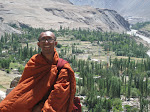
Sumanpal Bhikkhu
The exact date of the spread of Buddhism in Bengal at a propitious juncture of history is not known, but Buddhist literature mentions the Pundravardhana region, where the teachings of the Buddha were propagated during his time. Among the early disciples of the Buddha were Bangisha Thera and Bangantaputta, who were Bengalis. It is undeniable that the teachings of Buddhism enriched and enlivened the lives of the people of this land in many ways, and Bengal also played a significant role in the spread of Buddhism. Bengal is particularly a Buddhist land, as the soul of its civilization and culture is imbued with the ideas of the Buddha. Buddhism has progressed through two and a half millennia of development. And in the literary history of Bengal, there is a period of approximately one thousand years, known as the Charyapada. This early example of Bengali literature was written between the ninth and twelfth centuries CE.
Sanghanayaka Anandamitra Mahathera (1908-1999) is a worthy successor to this glorious tradition of our past. Due to his extraordinary knowledge of the Dharma and the humility of the Buddha, his meditative life, and his uniquely gentle nature, he is known as a symbol of Buddhist life in the Bengali Buddhist community. His place among the glorious monks of this subcontinent is unique.
On the new moon day of February 1, 1908, on the southeastern horizon of undivided India, in a small village called Andharmanik in the Raozan Thana of the present-day Chittagong district of Bangladesh, Jatindralal, the only son of Charapru Kabiraj and Damayanti Barua, was born. From childhood, Jatindralal was endowed with extraordinary talent and good health, yet he was simple and religious. Impressed by his exceptional talent, Dharmaraj Pandit, a resident of his village, taught him mathematics without any remuneration. While still in primary school, he easily passed the matriculation examination. After securing full marks in mathematics, Jatindralal passed primary school and enrolled in Binajuri Middle English School. There he achieved excellent marks in every class and passed the scholarship examination in the sixth grade. He then enrolled in Noapara High English School. In 1928, he passed his matriculation examination in the first division.
Young Jatindralal spent many days alone in the village's Buddhist monastery and the secluded cremation ground by the river. Sometimes he would meditate there and experience profound bliss. From his student days, he regularly accompanied his mother to the Uposatha observance. It was during this time that he came into contact with revolutionaries. Two villages near his birthplace, Noapara and Koyapara, were important centers for revolutionaries. The poet Nabin Chandra Sen and the revolutionary Masterda Surya Sen were born in Noapara.
After passing his matriculation examination, his parents initiated efforts to enroll their only son in medical college. To fulfill their wish, he set out on a journey to Yangon at the appropriate time. The famous Shwedagon Pagoda in Yangon deeply impressed him. This beautiful place captivated him so much that his mind became even more drawn to the ascetic life. Furthermore, seeing the peaceful and happy lives of the monks in Myanmar at that time, and observing the monasteries and renunciants in secluded places away from the local villages, his desire to lead an ascetic life intensified. 'Household life is bound by fetters, but the life of renunciation is boundless like the open sky' (Sambadho gharabasa rajapatho avokaso pabbajjā) – for someone who had internalized this saying of the Buddha, medical college was not the place to be. Disinterested in worldly life, Jatindralal returned to his homeland with a firm resolve to embrace the life of renunciation.
Upon returning to Chittagong, he sought permission from his parents to become a monk. But despite many attempts, he did not receive permission. When he was threatened with imprisonment for not granting permission for the ordination, the police finally granted him permission. Of course, it is also true that if Prabajit had not been Prabajit, there was a strong possibility that he would have gone to jail. This is because his name was recorded as a Swadeshi activist in the police records. During his student life, he came into contact with the Swadeshi student group and, due to his patriotism, was drawn to the freedom movement. And it is also undeniable that the qualities of courage and integrity that developed in him through this association remained with him until the last day of his life.
After overcoming numerous obstacles, he finally received ordination from the learned Dharmavamsa Mahasthavir at the Nandankanan Buddhist Monastery in Chittagong city in May 1930. At that time, his name was Anandamitra. But Anandamitra's quest for knowledge did not end there. Therefore, he left Chittagong city and received re-ordination from Vamsadeep Mahasthavir in Kartala in 1932. While living in Kartala, he established an organization called Tarun Sangha, started a weekly debate society, and published a handwritten newspaper called Tarun Jagaran with the aim of organizing the youth. On March 20 of the same year, he received the auspicious Upasampada (higher ordination) at the age of twenty-five under the guidance of Dandam Seema in Akiya. After the Upasampada, he came to Charaknai as instructed by his teacher and spent the rainy season in the monastery there.
On the first day of 1933, Bhikkhu Lokanatha, along with 272 monks and nuns from Myanmar and Sri Lanka, and Swedish monks from Yangon, embarked on a journey from the pagoda with the noble purpose of spreading the teachings of the Buddha. They visited various pilgrimage sites, including Bodh Gaya, and reached Chittagong on foot in March. Influenced by Bhikkhu Lokanatha's teachings, Anandamitra joined that great journey in Shakpura. When someone came to speak with him, Bhikkhu Lokanatha would first ascertain their identity, then listen to them, and only speak after understanding the suitability of the speaker. This quality of Bhikkhu Lokanatha was later inherited by Bhadanta Anandamitra. Lokanatha also joined the monks' journey and walked to Kolkata in twenty-three days and from there to Bardhaman in seven days. After traveling to various places, he returned to Charaknai village.
In 1935, at the invitation of some officials of the Bengal Buddhist Association and the renowned Indologist Dr. Benimadhab Barua, when Vanshadip Mahasthavir arrived in Kolkata as the headmaster of Dharmankur Vihara, Anandamitra again stayed in Kartala. But not finding mental peace there, he went to Akyab the following year. The seeker Anandamitra found the best place for meditation in a secluded forest far from his hometown. He spent most of his youth in the dense forest of Chhatarpitua, Betagi Banashram, and the Potali Mahashmashan in Akyab.
He lived a solitary life for five years (1937-41) in the Patharakilla Forest Hermitage and Kandy Forest Hermitage in Sri Lanka. He lived in a hut on a hill in a dense forest five or six miles from Chhatarpitua. His body became emaciated due to the rigorous Dhutanga vows, but he did not commit suicide. After that, he lived for six years (1947-52) in a hut on a hill about a mile north of Betagi village. From there, they crossed the vast plain south of the hill and visited the Buddhist monastery on the banks of the Karnaphuli River. They received unprecedented support from the villagers. They formed the Bihar Committee for the elders, the Pallimangal Committee for the youth, and the Navin Sangha for the students, bringing everyone together and organizing a meeting. Afterward, they stayed for two years in the neighboring village of Yogendraram, located at the foot of Mahamuni Pahartali village.
Anandamitra's name, as a virtuous monk and a humble ascetic, spread far and wide. While residing there, he brought about many changes in the area through his friendship and religious teachings. As a result of his stay, many of the local people's ignorance and superstitions were dispelled, and their lives became more joyful. Thus, Sanghanayaka Anandamitra is one of the greatest benefactors of the Bengali Buddhist community.
In May 1954, on the occasion of the 2500th anniversary of Buddha's birth, a Buddhist music festival was held in Yangon, the capital of Myanmar. Anandamitra Mahathera received an invitation to participate as a musician. From there, on July 12th, he traveled to Sri Lanka via Calcutta and Madras on a five-year scholarship. There he studied Buddhist philosophy for six years. He resided first at Palawatta Vihara and later at Atulmuni Vihara, and then spent about three years in a secluded monastery in Hanchapola village in early 1955. A mile away from there, he studied the Tripitaka at Saraswati Parivena for three years. For his profound scholarship in Buddhist philosophy and his mastery of the Tripitaka, the scholarly community of Sri Lanka honored him with the title of 'Tripitakavageshwara'.
Bhadanta Anandamitra returned to his homeland in 1960 and was greeted with grand public receptions in various villages of Chittagong, a testament to the international recognition of his scholarship. After residing at the Binajuri cremation ground for several years, he came to India on a Buddhist pilgrimage in 1963. In India, he studied at various institutions.
After completing his Buddhist pilgrimage, he decided to settle in India and acquired Indian citizenship. At the request of Jinratan Mahathera, the abbot of the beautiful Buddhist monastery in Shailashahar, Shillong, he went to Shillong. It is noteworthy that Karmayogi Kripasaran Mahasthavir, the founder of the Dharmankur Sabha and one of the pioneers of the revival of Buddhism in India, had established the Shillong monastery during his lifetime. Later, Karmavir Jinratan enriched this branch of the Dharmankur Sabha in various ways. Bhadanta Anandamitra stayed at the Shillong Buddhist monastery for three years (1964-67). Afterward, he traveled to different parts of India and resided at the Bodhisattva Monastery, the Lucknow branch of the Dharmankur Sabha.
In 1970, Indian Buddhist monks held their first All India Conference at the Thai Buddhist Monastery in Bodh Gaya to discuss their problems. The conference was presided over by the internationally renowned Buddhist monk and founder-director of Nabhananda Mahavihara, Jagdish Kashyap. At this conference, they realized the need for a central monastic organization and established an All India Monastic Organization. This organization is known as the All India Bhikkhu Sangha. The following were elected to the first executive council of the Bhikkhu Sangha:
Sangh leader: Jagadish Kashyap, Nalanda
Sanghanayaka: Anandamitra Mahathera, Bodh Gaya
General Secretary: Bhikkhu Prajnanandasri, Bodh Gaya
Joint Secretary: Gunachar Bhikkhu, Assam
Treasurer: Shasanvamsa Bhikkhu, Assam
Member: Jinaratna Mahathera, Meghalaya; H. Rashtrapala Bhikkhu, Maharashtra; Sugatananda Bhikkhu, Uttar Pradesh; Dharmapala Bhikkhu, Kolkata; Gnanananda Bhikkhu, Kolkata; Aloka Bhikkhu, Orissa.
Advisory Board: Dharmadhar Mahasthavir, Kolkata; Dr. Anand Kaushalyan, Nagpur; Dr. Dharmarakshit Mahathera, Sarnath; Acharya Buddharakshita, Bangalore; Dr. Chandrima Mahathera, Varanasi; Veer Dharmavar, Delhi and Dr. Rashtrapal Bhikkhu, Bodh Gaya.
Following the death of Sanghanayaka Jagdish Kashyap on January 26, 1975, Bhadanta Anandamitra Mahathera was unanimously elected Sanghanayaka at the Sangha convention in 1976. At that time, Dharmapala Mahathera, the General Secretary of the Buddhist Dharmankur Sabha, was the General Secretary of the Sangha. It was through his commendable efforts that the All India Bhikkhu Sangha was able to acquire land in Bodh Gaya. The two successful successors of Karmayogi Kripasaran, Jinaratna Mahathera and Dharmapala Mahathera, provided complete financial assistance for the acquisition of this land. No other member of the Sangha contributed a single penny towards the land acquisition. Currently, the Sangha's headquarters are located on this very land. The current office-bearers of the Sangha have shown a lack of gratitude by failing to remember these two prominent figures of the Sangha.
In 1971, he stayed at the Bodh Gaya Thai Buddhist Monastery at the invitation of its head monk. While there, he organized bhikkhu training camps and taught the rules of conduct to novice monks. He spent eight rainy seasons at this monastery at different times. In December 1973, he stayed at the home of the renowned philanthropist Hemendralal Barua in Ichapur, North 24 Parganas district, at his invitation. Here he practiced concentrated meditation and gifted several valuable books to the community.
In February 1983, under the auspices of the Government of Bangladesh, the Bangladesh Buddhist Kosti Prachar Sangha organized a program in Dhaka to commemorate the thousandth anniversary of the 10th-century Bengali scholar Atish Dipankar. The memory of participating in that international event with him is still fresh in my mind. On that day, two leaders of the Sangha – Anandamitra Mahathera and Vishuddhananda Mahathera – led a colorful peace procession through the heart of Dhaka city.
Bhadanta Anandamitra was a philosopher, scholar, teacher, social reformer, and writer. His books such as 'Satya-Sangraha', 'Satya-Sadhana', 'Amrita Sandhane', 'Anandalok', 'Dharmasudha', 'Mahamangal', 'Upasana', 'Prajna Sadhana', 'Buddha and His Dhamma', 'The Superiority of Buddha and His Dhamma', and 'Buddhism - A Humanistic Religion' are testaments to his profound knowledge and scholarship. Numerous quotations from his writings are noteworthy. This clearly demonstrates that Rabindranath was also immensely proficient in literature. Above all, he possessed a compassionate heart. He dedicated his entire life to transforming the society into which he was born into an ideal society. His social consciousness is clearly reflected in two booklets he wrote – 'Amar Samaj' and 'Adarsha Bauddha Jivan'. His first published booklet was 'Amar Samaj' (1955). In his later life, he wrote 'Adarsha Bauddha Jivan' (1977). The book 'Adarsha Bauddha Jivan' is enriched with his mature thoughts on the many problems and ignorance prevalent in the religious and social life of Bengali Buddhists. In the book's preface, he expresses the hope that “if a person endowed with qualities such as high aspirations, enthusiasm, and perseverance lacks knowledge of the right path, there is a strong possibility of their downfall and descent into vice. Therefore, this booklet shows those who take refuge in the great Buddha the path to living an ideal Buddhist life. If one can guide their life towards greatness by following the advice of progressive, discerning, all-knowing, and wise individuals and by performing good deeds according to their capacity, then they can attain this best of human lives.
Just as a physician has to administer painful injections and use instruments for the benefit of the people, similarly, in some cases, I have had to state unpleasant truths for the good of society. I have no desire to condemn or insult anyone. ... If a noble-minded, educated young man, by understanding the essence of the Buddha's religious and humble teachings, can practice boundless selflessness and renunciation, then some householders can become ideal examples.” Followers of Buddhism say, "If I can live a better life, I will consider my efforts successful." (Ideal Buddhist Life/Commentary/Pages 6-7/Publisher/All India Bhikkhu Sangha/Bodh Gaya/1977).
In 1976, I had a rare opportunity to become closer to him through the publication of this book. At first sight, I was drawn to both of them. He requested me to give the manuscript of the book to Sudhanshu Babu (the late Professor Sudhanshu Bimal Barua). Due to various commitments, the printing of the book was being delayed, so it would be better if I could assist him. I readily agreed. The book expresses gratitude for this – he (Sudhanshu Bimal Barua) and his dear friend Shri Hemendubikash Chowdhury meticulously proofread the booklet, striving to make it accurate and beautiful in every way. I wish you a long life and all-round well-being. Three decades later, on his birth centenary, the book was reprinted. By the Buddhist Dharmankur Sabha in 2007, on my own initiative, as co-editor of the Sabha.
In 1976, I had the rare opportunity to become closer to him through the publication of this book. From the very first glance, I was drawn to both of them. He requested that I give the book's manuscript to Sudhanshu Babu (the late Professor Sudhanshu Bimal Barua). Due to his busy schedule, the printing of the book was being delayed, so it would be best if I could assist him. I readily agreed. This is acknowledged in the book – he (Sudhanshu Bimal Barua) and his dear friend Shri Hemendubikash Chowdhury meticulously proofread the booklet, striving to make it accurate and beautiful in every way. I wish you a long life and all-round well-being. Three decades later, on his birth centenary, the book was reprinted. By the Bauddha Dharmankur Sabha in 2007, at my own initiative, as the co-editor of the Sabha.
Financed by the social worker Shri Shantiswarup Barua. The first edition was published with the financial support of Pandit Jinaratna Mahathera. The reason for the enthusiasm towards the reprinting of the book is that it beautifully articulates: how to become an ideal Buddhist, what are the qualities of an ideal donor, how the superiority of a monk is established, etc. Another significant problem has divided our society. That is the Nikaya problem. Many believe that the craving for self-governance and ego are the reasons for the differences within this Nikaya. The well-considered opinion of the renowned Indian philosopher Acharya Benimadhav Barua is: 'It is a great pity that the idea of uniting the Buddhist monks of Bengal has not yet occurred to any modern educated and young monk. What is the meaning of dividing those who follow the same scriptures, receive the same education, and are initiated into different sects?' If I could see that each sect had discovered a new theology, created a new ideology, and inspired new works, then I could understand the meaning of sectarian differences. "The differences among the Buddhist sects of Japan are of considerable importance, but there are no such differences among the Buddhist sects of Bengal." (Speech delivered at the Chittagong Buddhist Mahasabha held in Bhagirathnagar on March 12, 1938. For the full speech, interested readers may refer to the Dr. B.M. Barua Birth Centenary Commemoration Volume; Editor Hemendubikash Chowdhury/Buddha Dharmankur Sabha/1989). This insightful observation made by Dr. Barua nearly 75 years ago remains relevant even today. If the Bengali monks overcome these differences and unite, not only will the monastic order be strengthened, but the Buddhist community will also be revitalized with a unified consciousness and renewed enthusiasm. To alleviate suffering in human life, Gautama Buddha desired the emergence of Kalyanamitras (spiritual friends) throughout the world. This very group of Kalyanamitras constituted his Sangha of monks and nuns. Even when he had only sixty followers in Sarnath, a few days after the commencement of the Dharma Chakra, the Buddha instructed them: "Go forth and preach the Dharma, which is good in the beginning, good in the middle, and good in the end." The Buddha further explained to them: "Those monks who are establishing unity will establish unity. Among those who are friends, those who encourage friendship will be the monks who create unity, love unity, rejoice in unity, and speak words that generate unity, and this is a part of the teachings." (Silavanga 44/ Digha Nikaya).
For more than half a century, Sanghanayaka Anandamitra guided the Bengali Buddhist community. He inspired us to live ideal lives. He encouraged us to be mindful of our culture. There was no discrepancy between his words and his actions. His statements and deeds were one and the same. If there is no harmony between inner knowledge and outward behavior—that is, if we know one thing and say another—then there is no greater failure, no greater cowardice in life. In our present lives today, we see such cowardice spreading. The Buddhist society of Bengal is weak in terms of wealth and manpower. Moreover, disagreements and divisions have made our society even more vulnerable. Just as Sanghanayaka Anandamitra, as a friend of society, comforted the poor, encouraged the needy, and showed the path of truth to the common people during his lifetime; this saint, a symbol of the ideal Buddhist philosophy of life, remains a source of inspiration for us even today. Bhadanta Anandamitra praised the youth throughout his life. He had a special focus on the educated and young people of society. Only young and educated people, in the light of their youthful enthusiasm and knowledge, can properly guide society. When society becomes stagnant due to accumulated inertia, superstition, negative cultural practices, and illiteracy, then it is the responsibility of the awakened youth, the messengers of these young people, to break down the dilapidated walls of this stagnant state and spread the light of a healthy and beautiful life there. Bhadanta Anandamitra, a symbol of youth, repeatedly invoked the power of youth. Not only in his words, but also in his life, the power of youth found a source of inspiration. He neither formed any party nor any institution; nor did he aspire to any social organization or leadership. He did not engage in any kind of self-promotion. But he conquered himself. He is a self-conqueror. In the Dhammapada, the Buddha said:
He who has achieved the glory of victory
He who has defeated a thousand soldiers
He is a superior man
Who has conquered self-forgetfulness
He who has conquered himself
He is the blessed warrior. The ideals that the self-conquering Anandamitra Mahathera propagated throughout his life undoubtedly provide guidance for the Bengali Buddhist community of the 21st century. You will understand. Sanghanayaka Anandamitra is our guide. In Sanghanayaka Anandamitra, the embodiment of Buddhist philosophy, we find a personality whose presence makes life meaningful.
As I write this, I am reminded of some lines from the poem "The Great Man Who Survives Time" by the world-renowned author H.W. Longfellow:
The life of a great man teaches me his life's story, and I too can become glorious and eternal.
When they depart from this world, they leave behind the noise and clamor, leaving their footprints on the sands of time.

No comments:
Post a Comment