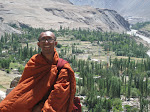
Sumanapal
Bhikkhu (Dr. Subhasis Barua)
Abstract:
[Buddhism
reached the area which is now Pakistan during the reign of Emperor Asoka
who sent a monk named Majjhantika from Varanasi for carrying the message of
the Buddha to Kashmir and Gandhar after the completion of the third
Buddhist Council held in his capital Pataliputra. The rock edict of Manasehra
and Shabaz Garhi written in Kharosthi in the middle of the 3rd Century BCE are
considered to be those among those writings which have been deciphered so
far.
The
next prominent king related to Buddhism of this area was Milinda. After his
discussion with the Buddhist monk Nagsena he converted to Buddhism in modern
Sialkot which was called Sagala at that time.
The
erstwhile Gandhara region which is now a part of presentday Pakistan and
Afghanistan is considered to be the cradle of Mahayana Buddhism which is one of
the major schools of the religion. In this area Gandhara Art, a combination of
Greek and Buddhist elements also flourished. The Kushana rulers like Emperor
Kanishka embraced Buddhism and also the elements of Hellenistic culture of the
Indo Greeks. Gandharian Buddhism reached its zenith during the reign of the
Kusanas.
The
period between 5th to 8th centuries CE saw a decline in the Sangha at the north
western part of India. We receive information about these events from the
writing of the Chinese pilgrims such as Fa xian, Xuan zang and Yi jing. This
was largely due to the invasion of Alcon Hun in the sixth century CE.
Xuan
zang informs us that the Huns razed a number of Buddhist monasteries and other
Buddhist establishments to the ground.
After
that Buddhism never really recovered in that area and gradually almost
disappeared.
According
to National Database and Registration Authority of Pakistan there were ,1492
Buddhists holding the national identity cards as against 1884 in 2017.
Pakistan
has some important places of Buddhist interest e. g. Taxila, Swat valley,
Takht-i- Bahi and Peshwar Valley, etc.
Some
famous Buddhist figures who are said to be associated with modern day Pakistan
are:
Khema,
wife of Bimbisara of Magadha 6th Century BCE (Sagala, now Sialkot).
Bhadda
Kapilani 6th Century BCE (Sagala now Sialkot).
Asanga
4th Century CE (Peshawar).
Vasubandhu
4th Century, CE (Peshawar).
Padmasambha
8th Century CE (Swat valley).
Though
Buddhism is no longer a potent and active force in Pakistan sensitive minds can
still hear footsteps among its stones that want to tell us the saga which
was played out for centuries.]
The
emergence of Buddhism represents a new era in human culture. It stood for a
divorce from the hairy tradition of the past, from the ignominy of the caste
system that proved to be a black spot for humanity. The spirit of this
emancipation of humanity spread as far as Japan in the east and Syria in the
West and ushered in a new dawn of progress and prosperity.
The
first stage was Buddhism was one of monastic seclusion but finally it came to
the foreground and gave birth to a brave new world to almost everything that
the human mind can comprehend, philosophical, social, ethical, linguistic,
literary and religious; and the entire known world was flooded by its benign
influence.
Buddhism
left a strong and indelible mark for the area for the north western region of
Pakistan. It reached the area during the reign of Asoka the Great who sent
a monk named Majjhantika from Varanasi for carrying the message of the Buddha
to Kashmir and Gandhar after the completion of the third Buddhist council held
in his capital Pataliputra.
Though
the Buddha probably during his life time did not set his foot anywhere beyond
the boundaries of Magadha and modern Uttar Pradesh tradition claims that he had
been to other places elsewhere in North West.
Buddha
was different from other eminent personages of India like Rama and Krishna
because unlike them he was a historical figure belonging to an identifiable
epoch of the past. He walked over the stone and mud of India tirelessly
delivering his sermons among the masses and when the end came the ashes of his
mortal body became a relic on which temples were built and his remains like
teeth, hair etc were preserved as valuable treasure.
History
tells that the north eastern portion of the Indian subcontinent had a different
fate from the rest of the country. For centuries they had been a part of the
Persian Achaemenian Empire and then after being annexed by Alexander it formed
a part of the Hellenistic empire. For a period, they belonged to the Mauryas
and then went under the control of Indo-Parthians, Scythians, Yavanas,
Kushanas and Hunas respectively. This part of Asia had a mixed history,
ranging from great social and political upheaval and periods of relative
calm and prosperity which produced great advancements in the field of art and
culture. This reached a new height when applied to Buddhist themes.
Though
Fa-xien found Buddhism in a somewhat decadent condition in rest of India with
both Lumbini and Kapilavatthu deserted and desolate in the North Western
portion the country the scenario was totally different. There hundreds of monks
were still active. The area which now constitutes West Pakistan was
traditionally advanced in art and craft. The area reached a very high degree of
expertise in trades like carpentry, ivory work, weaving, confectionery,
jewellery, pottery, garland making and head dressing. Trade and commerce were
highly developed in this area. Trade caravans frequently moved to east and west
and also crossed deserts and the journeys took days. The desert route started
from Magadha through Rajputana to Sindh and then further north to Gandhara. The
path had many dangers like drought famine, wild beasts and robbers.
Some
desert roots passed through Rajputana to ancient port of Bharukacha from
which goods were transmitted to Babylon. In those days Sindh was famous for its
pedigree horses which used to be exported everywhere of the known world. In the
North of Sindh lay the great highway that connected India with west and central
Asia. There was another highway connecting Magadha with Taxila, Peshwar and
Gandhar. The Jatakas have declared this route comparatively safe. Here we find
many instances of sons belonging to noble families making a solo journey to
Taxila for higher education.
Since
its inception until the arrival of Asoka the religion of the Buddha was mainly
monastic and confined to the recluse who sought for salvation by joining the
order and giving up all those things that bound them to earthly life. It
was Asoke the Great who elevated the religion to the status of a popular
religion which he propagated all over the known world. In the 19th or according
to some historians 21st years of his reign the emperor convened the third
Buddhist Council to ratify the order and purge it of heretics. It was Asoka's
dream to convert the whole of the then known world to his beloved faith and for
this he gave the responsibility to the monks who formed the missionary force.
Kashmir and Gandhar were under the Mauryan Empire and he sent the monk
Madhyantika to preach Buddhism there. It is said that the monk successfully
converted the whole of the area to Buddhism constituting of the present-day
North-West Frontier, North Punjab and the lower Indus Valley and the whole of
Kashmir. In this way the base was built upon which an elaborate system of art
and sculpture was built which came to be known as Gandhara Art.
Gandhara was the place where Hellenism in its eastward and Buddhism in its
westward journey ultimately converged and the result of this meeting was this
artistic blend.
It
was the Mauryan Empire which brought region of Gandhara within the boundary of
India for the first time. Before Alexander's arrival it had been a part of the
Persian Empire of the Achaemenians. Alexander was believed to have been driven
by the desire of subjugating the whole of Persian Empire. After the death of
Alexander Chandragupta Maurya, the founder of the Mauryan dynasty incorporated
this area for the first and the last time within the boundaries of India. After
the death of Asoka the Great this area being situated at a great distance from
the capital asserted its independence but was subjugated by the Bacterian Greek
who hailed from central Asia. In 190 B C Kabul valley and Gandhara were annexed
by the Bactrians who were a dynasty of Hellenistic rulers. The Bactrians
changed the cultural life of Gandhara and their most notable ruler was Milinda
or Menander. He extended his Kingdom farther east than Alexander had
done.
He
was the main character of the famous Buddhist book Milindapanha or the
Questions of Milinda. His capital is said to be Sagala or modern Sialkot. From
Milindapanha we come to know that Milinda was a disciple of the Buddhist monk
Nagasena. Then political control of the area gradually passed to the Sakas
and Pallavas and then to the Kushanas. Gradually the Kushanas conquered the
whole of Indo Gangetic plain. The empire of Kanishka the greatest ruler of this
dynasty stretched from frontiers of China to the frontiers of Gujarat. Like
Asoka Kanishka embraced Buddhism and he took the help of Buddhist scriptures to
solve the problems related to the state. He was confused when he saw the great
difference in the opinion of various Buddhist teachers. Parsha one of the
leading Buddhist monks of the time said to him that since the Buddha had died
long ago his followers were forgetting what he actually taught. So
Kanishka convened the Fourth Buddhist Council presided over by Vasumitra. After
a long discussion the commentaries on the Pitakas were composed and these constituted
of 300000 verses. Then these commentaries were engraved on copper plates which
in turn was placed inside a stone chest and was deposited in a stupa for safe
keeping. Though Kanishka tried to remove the differences in the thoughts of
various schools of Buddhism it was almost at this time a great schism occurred
in Buddhism which divided the religion into two main sects namely Hinayana or
the Little Vehicle and Mahayana or the Great Vehicle.
During
the reign of Kanishka the plastic art of Gandhara reached its zenith. During
the reign of the Maurya dynasty and that of the Sunga dynasty that succeeded it
very few monuments were built. At that time the contribution of the Buddhist
school of art was confined to the construction of the stupas of Bharhut and
Sanchi. The pre-Gandhara Buddhist art was conspicuous in the absence of Buddha
the Man whose life and former existences the artists were endeavouring to
capture on stones and colour paintings. They believed that the image of
the Buddha could not be represented in human form because he had moved beyond
all forms and attributes. With the advent of Mahayana the Buddha came to
be regarded as a Celestial Entity and the devotees who were no longer satisfied
with the symbol like a throne left vacant that represented the invisible
presence of the Master were craving for a glimpse of Him or at least of His
image. The Buddhist canon did not forbid such representation it was withheld
only by custom. Mahayana which stood for a completely new outlook and
philosophy soon divorced itself from tradition and the only problem which stood
in the way of the artist was finding a model which would provide him with the
form and feature of the Buddha. The problem was solved by the Hellenistic
tradition which had already been firmly established in Gandhara and its
adjoining areas. During that time the people were considerably influenced by
the Hellenistic tradition of art and that led to the personification of the
Buddha with Olympian characteristics. Gradually Buddha images created in this
way could be seen in the temples and shrines all over the Buddhist world
including Cambodia, Thailand and Burma and later to China, Japan and
Tibet. In all probability it was the reign of Menander in which a combination
of eastern and western tradition of art blended themselves into a perfect
synthesis that ultimately gave rise to the Gandhara art. Buddhism received
ample patronage from the Greek kings and the Kushanas who succeeded them the
area around Gandhara came to be known as a stronghold of Buddhism. It was
even claimed that Buddha "came there to save the country from several
catastrophies" According to legend the Buddha came there in person to
subdue the Nagraja of Swatriver who inundated the entire surrounding area once
a year. According to another legend he subdued the ogress of small pox.
In
this way being strengthened with legend and the patronage of the Buddhist kings
Gandhara became the holy land of Buddhism. Its fame rose to such an extent that
some Chinese pilgrims satisfied themselves with a visit to Gandhara without
venturing towards the Magadha region.
The
Kushanas Empire declined after the death of Vaudeva in 225 AD and from then on
the history of Gandhara became obscure. But the remaining glory of Gandhara is
described by Fa Hien who visited the subcontinent around 400 AD. According to
him there were still 700 monks serving the Patrachditya at Purushpur or
Peshawar. Around the time of Fa-xien's visit to India the bad time for Buddhism
had set in in India due to religious persecution. However, in the region
of Gandhara Buddhism enjoyed a safe existence. During that period Buddhist art
in Gandhara reached a new height but it received a cruel blow when the white
Huns ravaged the area. Son-Yun who visited the Indian subcontinent in 520 A.D
found Gandhara.
In
a state of absolute desolation. However, he gave a description of the glory of
Poly Sha (Shebaz Garhi) with its beautiful and dazzling images of gold. But
fifteen years later Mihirgula the Hun destroyed sixteen hundred Buddhist
religious institution of the area, killed two thirds of his inhabitants and the
rest were reduced to slavery.
Though
almost all the vestiges of Gandhara art were destroyed as a result of
persecution mainly by the Huns under Mihirkula some of its specimens can still
be seen in the museums of Pakistan, India, Germany, France and the United
States of America.
Now
we may discuss some of the important Buddhist sites in modern Pakistan:
Charsada
and Puskalavati:
Among
the Buddhist sites discovered in Pakistan the following are the most important.
These sites bear mute witness to rich cultural heritage of Ashoka and of
Gandhara.
They
are:
(I)
Taxila: An ancient city studded with innumerable Buddhist stupas,
monasteries and artifacts. Most of the archaeological sites of this place
is situated around Taxila museum. For more than a millennia Taxila retained its
glory as a centre of Buddhist art, architecture and education. Taxila possess
more than 50 Buddhist sites. Among them we may mention Dharmarajika Stupa and
monastery (300 B.C.-- 200 A.D) Bhir Mound (600B.C-- 200B.C), Sirkap (200BC--
600 A D.), Jandial Temples (c 250 B.C.), and Jaulian monastery (200-600A.D).
There is a museum close to the site in which the rich archaeological finds of
Taxila have been kept in chronological order and with proper label. According
to Hiuen Tsang there were four great stupas in Gandhara. The first was
the stupa of Elapatra or the dragon king (Nag Raja), the second was
the stupa that marked the place which according to the Buddha would yield four
great treasures at the time of the arrival of Buddha as Maitreya. The third
stupa marked the place of the sacrifice of head and the fourth was built on the
place where Prince Kunala 's (son of emperor Asoka) were pulled out by the
order of Asoka's queen Tishya- Rakshita.
The
stupa of Naga Raja has now been identified as the tank of Hasan Abdal which is
now known as the tank of Panja Shah. The second and third stupas have been
identified with the ruins on the ridge of the Baoti Pind, and the Bhallar Stupa
crowning the western ridge of the Sarda hill. Archaeologists initially were
unable to identify the location of Kunala stupa but after prolonged research
Marshal identified it over the ridge of Hathial which commands the whole of the
Hare valley.
The
monastery and Stupa of Jaulian present us with a specimen of decadent Buddhism.
The remains are the plinth of a large Stupa surrounded by a small wall.
The upper story is almost utterly in ruins. Alongside the big assembly hall, we
can find other large rooms and dining hall which provided space for
kitchen and dining hall which signify a break with the old tradition which
required the monks to live austere life and collect food through begging.
(ii)
Takht-i-bari: A large Buddhist monastery located in Khyber Pakhtunkhwa.
It was excavated in the beginning of the twentieth century and in 1989 UNESCO
included it in the list of its World Heritage site. Apart from that there is
Seri Bahlol urban remains belonging to the same era situated about a kilometre
south.
(iii)
Swat Valley: Swat Valley is famous for its Buddhist towers, monasteries
and as the place of origin of the famous Gandhara Buddhist art. It is said to
be the cradle Vajrayana Buddhism because it was the birth place of Guru
Padmasambhava the Eighth century Buddhist monk who is given the credit of the
dissemination of Buddhism in Tibet.
(iv)
Gilgit-Baltistan: Here we find the Manthala Buddhist rock with eighth
century engravings and the Second Rock of Hunza. The former sites of Buddhist
shelters can also be seen nearby Balochistan.
(v)
Balochistan: Hiuen Tsang or Xuan Zang the Chinese Buddhist traveller
reported found many Buddhist sites in coastal region of Makran, Balochistan.
Godrani caves or the remnants of the Buddhist cave city exists even
today.
(vi)
Sindh: Though there are many Buddhist sites in Sindh they are not
properly preserved. Among the sites of Brahmanabad (Mansura) we may mention the
Buddhist stupa at Mahenjodaro, Sirah- ji- takri near Rohri sukkur. Many
terracotta from Kaho-jo-daro and Buddha statues are exhibited in Chhatrapati
Shivaji Museum of Mumbai.
Famous
Buddhist Personalities of Pakistan:
Many
eminent personalities associated with Buddhism are connected with Pakistan.
Among them we can mention the following:
(I)
Asanga: (4th century CE): He was born in Peshawar and was the founder of
Yogacara School of Mahayana Buddhism.
(ii)
Vasubandhu: (4th-5th Century CE): He was a famous Buddhist scholar and
philosopher and also the brother of Asanga.
(iii)
Padmasambhava: He was born in Swat Valley (Uddiyana) He spread Vajrayana
Buddhism to Tibet and there he is regarded as the second Buddha.
Kumarlata: He was a famous Buddhist philosopher and author who
originated in the 3rd century CE.
Khema
and Bhadda Kapilani: They were early
Buddhist personalities associated with Gandhara region.
Inspite
of its rich heritage Buddhism is very nominally practice in Pakistan. Only a
small indigenous community called the Baori Buddhists (roughly 650 families)
resides in rural South and south Punjab.
Pakistan
contains a very large unexplored potential for promoting Buddhist tourism if
adequate security is provided to the foreign tourists. The UNESCO had declared
six places of Pakistan as World Heritage sites and twenty-six others appear in
the tentative list. However, Pakistan is unable to take advantage of this
situation because of bureaucratic red tape, law and order issues, religious
extremism and denigration of religious minority ceremonies and sites.
Various Governments of the country have not showed any interest or regard for
their Buddhist heritage and tradition. To compensate these drawbacks Pakistan
has to adopt a more tourism friendly attitude. It is the duty of the Government
in Pakistan to develop a blue print for this purpose. However, the Government
of Pakistan has taken steps to preserve various Buddhist sites like the Landi
Kotal Stupa and Jamal Garhi in Gandhara.
Though
Buddhism is no longer a potent and active force in Pakistan sensitive minds can
still hear the footsteps of the Buddha among its stones that
want to tell us the saga that was played out for centuries.
Bibliography:
1. Buddhism in Pakistan, A Pakistani Buddhist, (1960),
Pakistan Publication, Karachi, Pakistan.
2. Xin-ru Liu, (2010), The Silk Road in World
History, New York: Oxford University Press.
3. Kurt A.
Behrendt, (2004), The Buddhist architecture of Gandhara, Handbuch der
Oriental istik Brill.
4. Kurt Behrendt, and Pia Brancaccio, (2000), Gandharan
Buddhism: Archaeology, Art, and Texts.
5. Mukherjee, Bratindra Nath, (1996), India in Early
Central Asia. Calcutta.
6. Williams, Paul, (2008), Mahāyāna Buddhism: The
Doctrinal Foundations.
7. Samad, Rafi-us, The Grandeur of Gandhara. The Ancient
Buddhist Civilization of the Swat, Peshawar, Kabul and Indus Valleys.
8. Nakamura, Hajime, (1999), Indian Buddhism:
A Survey with Biographical Notes.
9. Williams, Paul, (2008), Mahāyāna Buddhism: The
Doctrinal Foundations.
10. Walser, Joseph, (2005), Nagarjuna in Context: Mahayana
Buddhism and Early Indian Culture, Columbia University Press.
11. Khaliq, Fazal, (2016). "Iconic Buddha in Swat valley restored after nine years when Taliban defaced it". DAWN.
12. Murthy, K. Krishna, (1987), Glimpses of Art, Architecture, and Buddhist Literature in Ancient India. Abhinav Publications. New Delhi.
13. Puri, Baij Nath (1987). Buddhism in central Asia, Motilal
Banarsidass Publishers Ltd. New Delhi.
14. D.C. Ahir: Buddhism in North India and Pakistan
(Bibliotheca Indo-Buddhica series, 1998).
15. UNESCO: The Buddhist Heritage of Pakistan, Legends,
Monasteries and Paradise. (2008).
16. Shah Safdar Al: The Buddhist Heritage of Pakistan.
17. Kurt A. Behrendt: The Buddhist Heritage of Pakistan:
Art of Gandhara.

No comments:
Post a Comment